
Spaces:
Running
on
Zero


🎨 Add-it: Training-Free Object Insertion in Images With Pretrained Diffusion Models


👥 Authors
Yoad Tewel1,2, Rinon Gal1,2, Dvir Samuel3, Yuval Atzmon1, Lior Wolf2, Gal Chechik1
1NVIDIA • 2Tel Aviv University • 3Bar-Ilan University
📄 Abstract
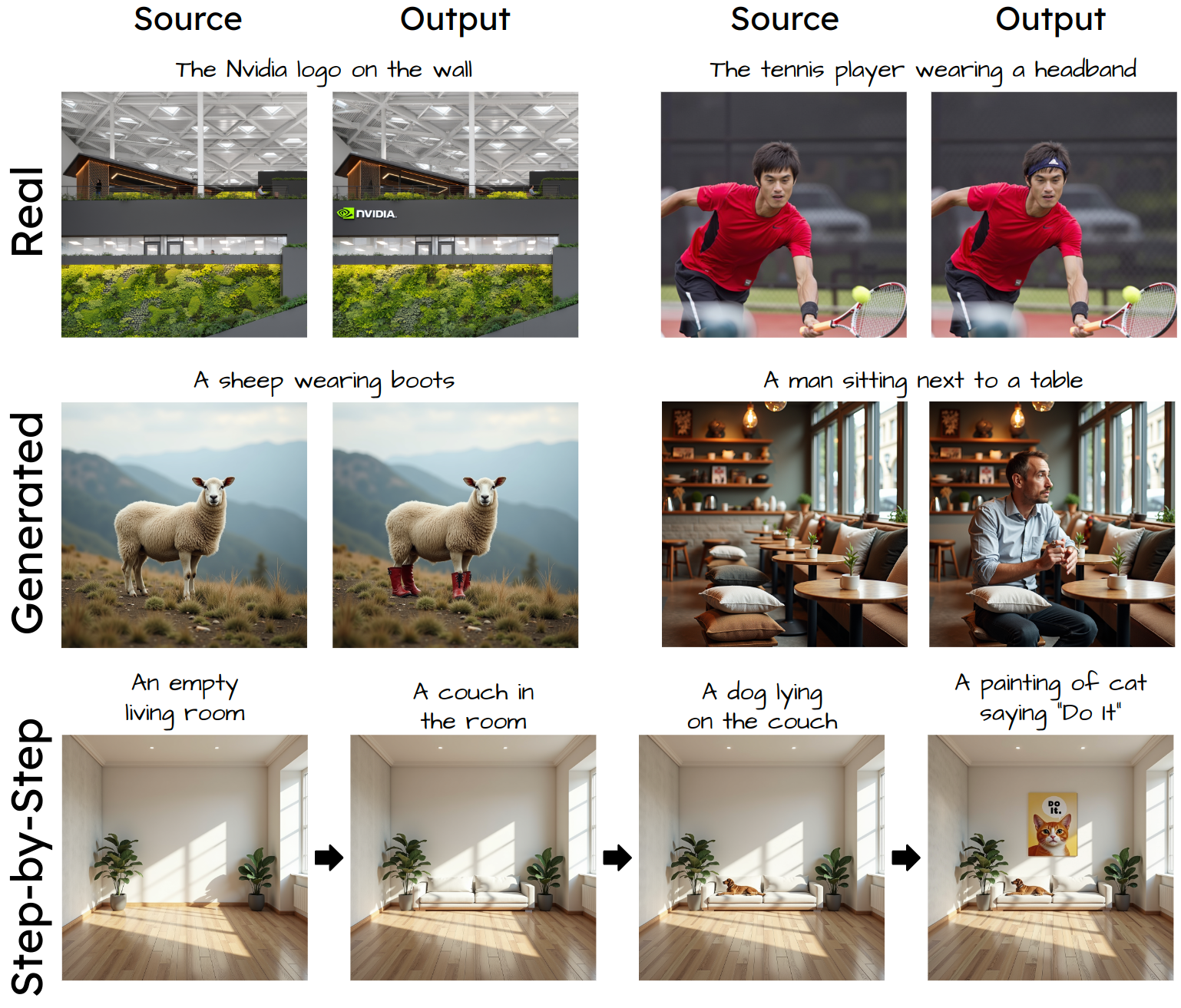
Adding objects into images based on text instructions is a challenging task in semantic image editing, requiring a balance between preserving the original scene and seamlessly integrating the new object in a fitting location. Despite extensive efforts, existing models often struggle with this balance, particularly with finding a natural location for adding an object in complex scenes.
We introduce Add-it, a training-free approach that extends diffusion models' attention mechanisms to incorporate information from three key sources: the scene image, the text prompt, and the generated image itself. Our weighted extended-attention mechanism maintains structural consistency and fine details while ensuring natural object placement.
Without task-specific fine-tuning, Add-it achieves state-of-the-art results on both real and generated image insertion benchmarks, including our newly constructed "Additing Affordance Benchmark" for evaluating object placement plausibility, outperforming supervised methods. Human evaluations show that Add-it is preferred in over 80% of cases, and it also demonstrates improvements in various automated metrics.
📋 Description
This repository contains the official implementation of the Add-it paper, providing tools for seamless object insertion into images using pretrained diffusion models.
🛠️ Setup
conda env create -f environment.yml
conda activate addit
🚀 Usage
💻 Command Line Interface (CLI)
Add-it provides two CLI scripts for different use cases:
1. 🎭 Adding Objects to Generated Images
Use run_CLI_addit_generated.py to add objects to AI-generated images:
python run_CLI_addit_generated.py \
    --prompt_source "A photo of a cat sitting on the couch" \
    --prompt_target "A photo of a cat wearing a red hat sitting on the couch" \
    --subject_token "hat"
⚙️ Options for Generated Images
🔴 Required Arguments:
--prompt_source: Source prompt for generating the base image--prompt_target: Target prompt describing the desired edited image--subject_token: Single token representing the subject to add (must appear in prompt_target)
🔵 Optional Arguments:
--output_dir: Directory to save output images (default: "outputs")--seed_src: Seed for source generation (default: 6311)--seed_obj: Seed for edited image generation (default: 1)--extended_scale: Extended attention scale (default: 1.05)--structure_transfer_step: Structure transfer step (default: 2)--blend_steps: Blend steps (default: [15]). To allow for changes in the input image pass--blend_stepswith empty value.--localization_model: Localization model (default: "attention_points_sam")- Options:
attention_points_sam,attention,attention_box_sam,attention_mask_sam,grounding_sam
- Options:
--show_attention: Show attention maps using pyplot (flag), will be saved toattn_vis.png.
2. 📸 Adding Objects to Real Images
Use run_CLI_addit_real.py to add objects to existing images:
python run_CLI_addit_real.py \
    --source_image "images/bed_dark_room.jpg" \
    --prompt_source "A photo of a bed in a dark room" \
    --prompt_target "A photo of a dog lying on a bed in a dark room" \
    --subject_token "dog"
⚙️ Options for Real Images
🔴 Required Arguments:
--source_image: Path to the source image (default: "images/bed_dark_room.jpg")--prompt_source: Source prompt describing the original image--prompt_target: Target prompt describing the desired edited image--subject_token: Subject token to add to the image (must appear in prompt_target)
🔵 Optional Arguments:
--output_dir: Directory to save output images (default: "outputs")--seed_src: Seed for source generation (default: 6311)--seed_obj: Seed for edited image generation (default: 1)--extended_scale: Extended attention scale (default: 1.1)--structure_transfer_step: Structure transfer step (default: 4)--blend_steps: Blend steps (default: [18]). To allow for changes in the input image pass--blend_stepswith empty value.--localization_model: Localization model (default: "attention")- Options:
attention_points_sam,attention,attention_box_sam,attention_mask_sam,grounding_sam
- Options:
--use_offset: Use offset in processing (flag)--show_attention: Show attention maps using pyplot (flag), will be saved toattn_vis.png.--disable_inversion: Disable source image inversion (flag)
📓 Jupyter Notebooks
You can run Add-it in two interactive modes:
| Mode | Notebook | Description |
|---|---|---|
| 🎭 Generated Images | run_addit_generated.ipynb |
Adding objects to AI-generated images |
| 📸 Real Images | run_addit_real.ipynb |
Adding objects to existing real images |
The notebooks contain examples of different prompts and parameters that can be adjusted to control the object insertion process.
💡 Tips for Better Results
- Prompt Design: The
--prompt_targetshould be similar to the--prompt_source, but include a description of the new object to insert - Seed Variation: Try different values for
--seed_obj- some prompts may require a few attempts to get satisfying results - Localization Models: The most effective
--localization_modeloptions areattention_points_samandattention. Use the--show_attentionflag to visualize localization performance - Object Placement Issues: If the object is not added to the image:
- Try decreasing
--structure_transfer_step - Try increasing
--extended_scale
- Try decreasing
- Flexibility: To allow more flexibility in modifying the source image, set
--blend_stepsto an empty value to send an empty list:[]
📰 News
- 🎉 2025 JUL: Official Add-it implementation is released!
📝 TODO
- Release code
📚 Citation
If you make use of our work, please cite our paper:
@misc{tewel2024addit,
    title={Add-it: Training-Free Object Insertion in Images With Pretrained Diffusion Models},
    author={Yoad Tewel and Rinon Gal and Dvir Samuel and Yuval Atzmon and Lior Wolf and Gal Chechik},
    year={2024},
    eprint={2411.07232},
    archivePrefix={arXiv},
    primaryClass={cs.CV}
}